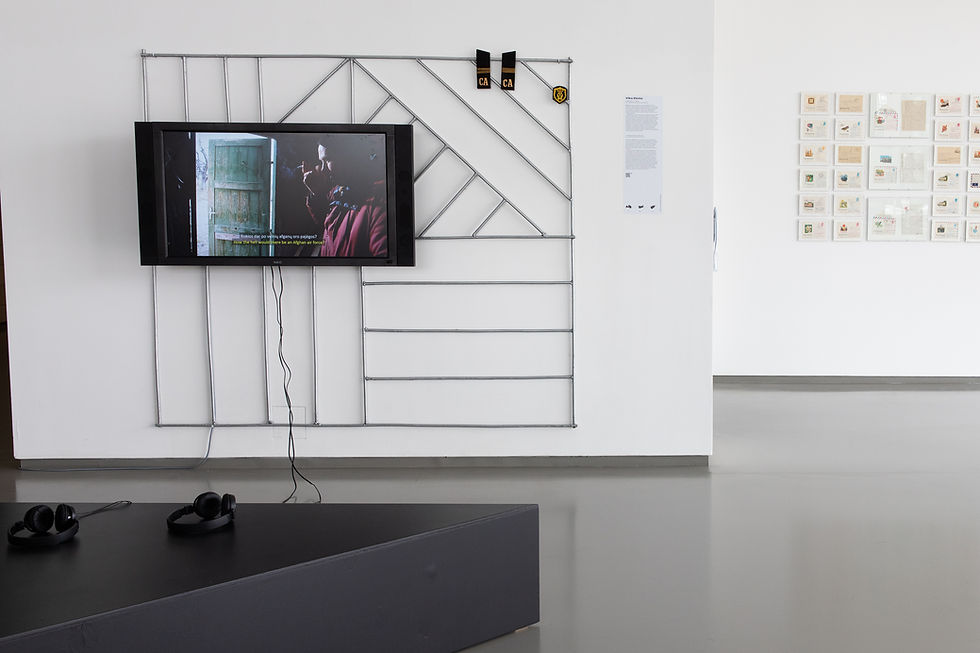


This video installation was created for the international group exhibition "Difficult pasts. Connected worlds" curated by Ieva Astahovska and Margaret Tali. It was shown in Latvian National museum of Art (Riga, 2021), National Gallery of Art (Vilnius, 2022) and Tallin Art Hall (2024). It is an exploration of war trauma based on artist's family history.
Video is avaliable upon request.
The Soviet Union’s military policy has a long history of so-called double colonialism, expanding its territories and areas of impact by enlisting people from already colonised places. The Soviet–Afghan War (1979–89) was the most brutal military conflict of the late Soviet period. Many young people (about 10,000 from the Baltic States) were assigned to the Soviet army on a mandatory basis and were thus drawn into this war against their will. More than 15,000 Soviet soldiers were killed during this war, while on the Afghan side, about three million people died, most of them civilians and millions became refugees.
The artist writes: “My father got into the war in Afghanistan at the beginning of the conflict and spent ten months as a sergeant in the air defense (missile) division. Like most of the soldiers, he was drafted there soon after graduating school. My dad has talked little and reluctantly about this experience, saying that he can only be understood by those who have experienced it themselves, and that no one is interested in this war today. For many victims of the Soviet–Afghan War, the psychological trauma led to severe experiences and destructive behavior, which also affected the lives of their families. In the US, the term ‘Vietnam Syndrome’ was coined in response to the injury of Vietnam War veterans, but in the USSR, the press praised the heroism of former soldiers and promoted “masculine silence” on the most painful aspects.